The Financial Situation of Health Insurance Companies
The explanatory memorandum to the bill paints a grim picture of the finances of the statutory health insurance system: Without legislative intervention, a funding shortfall of 15.3 billion euros is projected for 2027, which could grow to around 40.4 billion euros by 2030. The main driver of this trend is the growth in expenditures.
The urgency of the proceedings has intensified once again shortly before the parliamentary debate. According to the latest data from Federal Health Minister Nina Warken (CDU), health insurance expenditures this year are approximately 3.5 billion euros higher than projected. Since a financial buffer originally set aside for this purpose has already been exhausted, an additional, unforeseen shortfall of 2.5 billion euros remains. Regardless, the legislative process is to be completed before the parliamentary summer recess in order to realize the cost-relief effects in a timely manner.
The Key Measures of the Austerity Package
The GKV-BStabG provides for a broad sharing of the burden that involves service providers, manufacturers, health insurance plans, and insured individuals alike. Key measures include, among others:
# Remuneration Cap in the System: Annual fee and remuneration increases in all service areas, as well as in administration, will be linked to actual cost trends or the base wage rate. From 2027 to 2029, a flat-rate reduction of one percentage point will also be applied. Extra-budgetary additional payments for certain medical practice services will be eliminated.
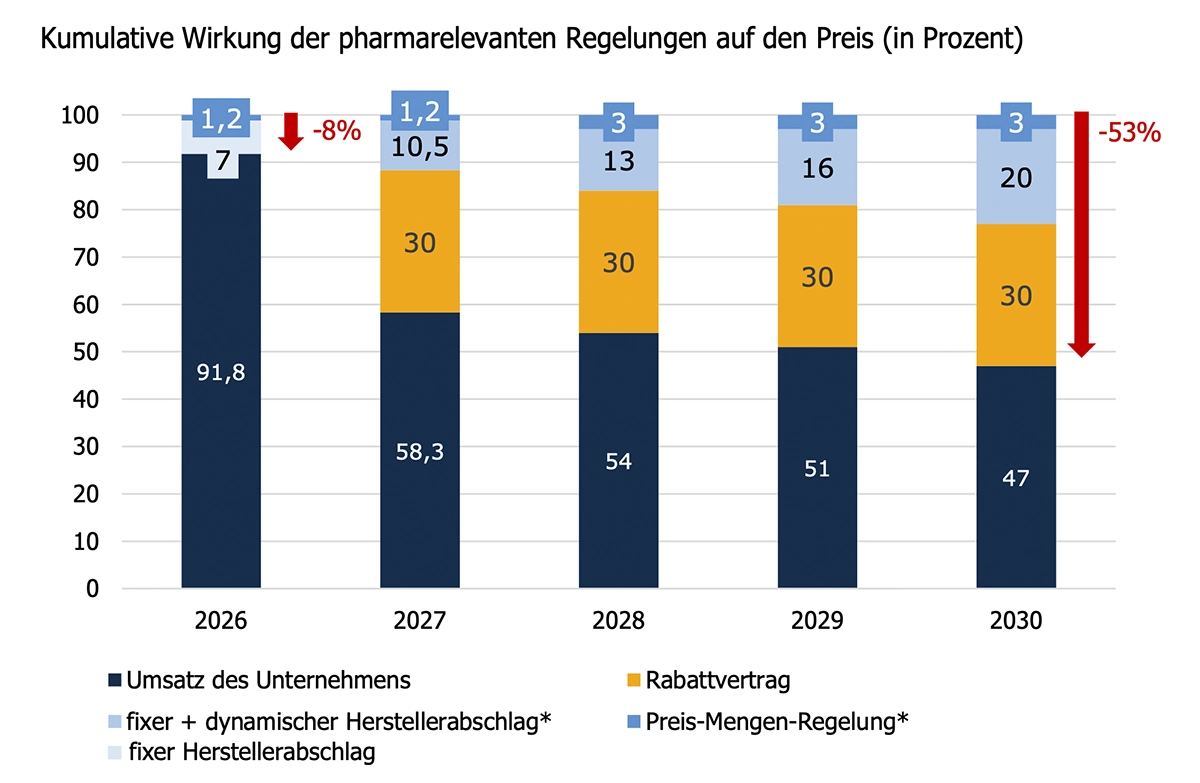
# Regulations in the pharmaceutical sector: The pharmacy discount will be increased from 1.77 euros to 2.07 euros per package. For research-based pharmaceutical companies, the introduction of an additional dynamic manufacturer discount for patent-protected drugs is planned. Starting in July 2027, this discount will be determined based on data using a target-actual expenditure model for the market. New active ingredients will be exempt only if a significant portion of clinical trials and production takes place in Germany.
The Pharmaceutical Industry's Position: Job Security at Risk
The pharmaceuticals and medical devices sector bears the greatest regulatory and financial burden of the reform. From the perspective of global pharmaceutical and medtech companies, the measures represent a far-reaching intervention in pricing and contract law. The dynamic manufacturer discount, in particular, has been criticized because it links price calculations to overall market trends, thereby creating a significant ex ante planning risk for companies.
The reactions of international corporations reflect this skepticism in the form of concrete investment reviews:
▪ Pfizer: CEO Albert Bourla addressed the changed situation in a letter to Chancellor Friedrich Merz and announced a review of the timeline and scope of the investments planned for the site in Germany. Bourla canceled his participation in an international investor conference scheduled for the fall.
▪ Eli Lilly and Boehringer Ingelheim: According to reports, Eli Lilly is considering a planned major investment of 2.3 billion euros for a production facility in Rhineland-Palatinate. The German pharmaceutical company Boehringer Ingelheim has scrapped planned investments of more than 900 million euros in Germany. Management noted that, under these conditions, new developments would be more likely to be based in the U.S. or Asia.
▪ Novartis and Roche: Novartis CEO Vas Narasimhan criticized the signals sent by German health policy to a highly innovative industry, while regions such as the U.S. and China are actively promoting their biotech ecosystems. Although Roche is continuing existing infrastructure projects, it announced that it would fundamentally reassess future research and production decisions in Germany.
▪ AstraZeneca: CEO Pascal Soriot emphasized that, compared to the U.S., European healthcare systems spend significantly less of their gross domestic product (GDP) on new drugs (an estimated 0.4 percent in Europe versus 0.8 percent in the U.S.). This forces companies, from a strategic standpoint, to focus new product launches primarily on the U.S. market.
The Opposing View: Equitable Distribution and Cost Control
In response to the criticism regarding location risk, statutory health insurers and supporters of the reform point to the economic realities of the German market. Stefanie Stoff-Ahnis, deputy chair of the board of the GKV-Spitzenverband, emphasizes the high attractiveness of the German market, which, with approximately 75 million insured individuals and rapid patient access to innovations, continues to offer excellent conditions.
Health insurance companies point to a significant surge in spending in recent years: Between 2012 and 2025, the statutory health insurance system’s spending on medications rose from 27 billion to 59 billion euros. The main cause is identified as price trends for patented drugs, whose average daily treatment costs increased by 182 percent during the same period.
From the perspective of the statutory health insurance system, the pharmaceutical industry’s participation in cost-saving efforts is a matter of distributive justice. Stoff-Ahnis also believes that industrial policy and securing the business environment are not core responsibilities of the statutory health insurance system. Rather, excessive spending on medications and the resulting rise in non-wage labor costs represent a macroeconomic burden on the business environment as a whole.
Ways Out of Confrontation: Cooperation and Technological Efficiency
Beyond the political infighting over price cuts and budget caps, the focus is increasingly shifting to solutions that could advance the healthcare system through structural reforms and partnerships. A key lever lies in cross-sector collaboration. Industry representatives emphasize that sustainable progress does not result solely from debates over funding, but rather from cooperation between industry, hospitals, academia, and outpatient facilities along real patient pathways. Such integrated partnerships make it possible to efficiently close gaps in care at the system’s interfaces.
Another approach that purely adds value is the massive increase in process efficiency through the use of state-of-the-art technologies. Major pharmaceutical companies are currently stepping up their investments in specialized, vertical AI systems. Biological AI platforms, such as those currently being piloted by companies like Pfizer and Sanofi, are capable of precisely predicting molecular interactions. This allows lengthy phases of drug development—which can take years—to be condensed into short, highly efficient sprints. In addition, data-driven systems, such as those used at Novo Nordisk, enable clinical trials to be simulated virtually in advance. This drastically shortens development timelines, reduces R&D costs, and brings innovative therapies to patients faster and with fewer errors.
The legislature has also incorporated a collaborative steering mechanism into the current draft: The planned exemption from the dynamic manufacturer discount for new active pharmaceutical ingredients is specifically tied to the condition that clinical trials and the production of the active pharmaceutical ingredients take place, to a significant extent, in Germany. Thus, there is also legislation that is certainly capable of combining cost control with targeted incentives to preserve the domestic research and production infrastructure.
___________________________________________________________________
Background Information:
Although the bill does not require approval by the Bundesrat, the Bundesrat can only delay—but not block—its entry into force on January 1, 2027. However, since both the federal states and parts of the governing coalition are calling for substantial changes, intensive negotiations on the exact details of the pharmaceutical rebates and hospital reimbursements are expected during the upcoming committee proceedings.