Preliminary Results from Moderna and Merck
Moderna and Merck (MSD) reported positive results for a new dual therapy for melanoma. Patients who had their tumors surgically removed received the new mRNA vaccine in addition to the current standard treatment. The result: The combination provides significantly more effective protection against recurrence than the previous single-agent therapy.
“For years, the idea of a personalized mRNA cancer therapy sounded like science fiction. Today, we have demonstrated its clinical benefit in a global Phase 3 trial.”
Moderna CEO Stéphane Bancel on the Results of Personalized Genetic Testing
Mechanism of Action: What mRNA and Personalized Vaccines Mean
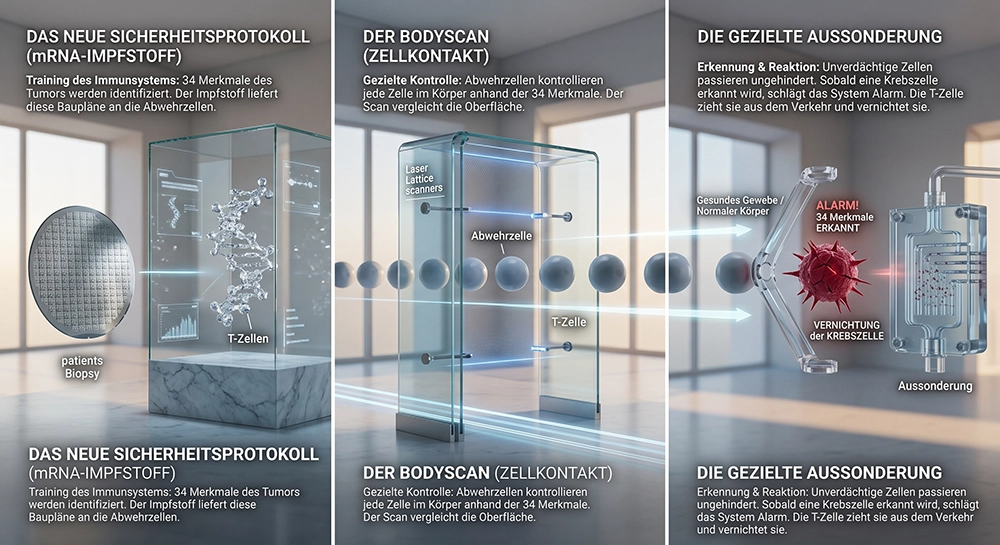
Unlike preventive vaccines, this is a therapeutic vaccine used in people who already have cancer. After the tumor is surgically removed, the tissue is genetically analyzed to identify the mutations (neoantigens) specific to that type of cancer. Based on this, an individualized vaccine (Intismeran Autogen) containing up to 34 specific neoantigen structures is programmed in the laboratory for each patient.
Within the cells, the mRNA acts as a temporary blueprint for the selected target structures of the cancer cells. These target structures are produced by the body’s own cells based on the blueprint and presented to the immune system. In this way, the immune system learns to recognize these target structures and to specifically target cancer cells.
The principle can be understood in the same way as airport security screening: The mRNA vaccine alerts the security personnel (= our immune cells) to a hidden threat. As the “passengers” are screened, the immune cells let all healthy cells pass without issue. However, as soon as a remaining cancer cell passes through the scanner, the system immediately sounds the alarm, and the cell is specifically neutralized. (Explanatory graphic: Generated using AI.)
Additional indications and companies conducting research
Research into mRNA therapies is not limited to melanoma. The consortium consisting of Moderna and Merck is testing the combination of intismeran and pembrolizumab as part of the “INTerpath” program in additional Phase II and III clinical trials, including for non-small-cell lung cancer, bladder cancer, and renal cell carcinoma.
At the same time, BioNTech is working on mRNA-based cancer therapies. Clinical development efforts are focused, among other things, on studies of colorectal cancer and pancreatic cancer. In addition to oncology, the range of applications for mRNA technology extends to vaccines against infectious diseases such as influenza, as well as to non-immunological mRNA therapeutics for the treatment of congenital genetic disorders.
Opportunities and Challenges
The key advantage of the mRNA platform lies in its biological adaptability to different tumor types and disease patterns. If the approach proves to be effective over the long term in further studies, immuno-oncology could serve as a clinical complement to the three traditional forms of treatment (surgery, chemotherapy, and radiation therapy).
However, there are several operational and economic hurdles:
- Manufacturing Effort: Identifying individual neoantigens and the subsequent production of the therapy require a complex, time-sensitive process for each individual patient.
- Current evidence: Reliable analyses of long-term overall survival are still pending in the ongoing studies.
- Cost Structure: The high cost of development and the potential dominance of a few providers pose the risk of high treatment costs for health care systems.
- Relocation of Production Capacity: Industrial competition also affects infrastructure: While BioNTech has announced the closure of sites in Germany, Moderna is considering acquiring these facilities to secure its own European production capacity.
Assessment from a medical perspective
Joe Oppermann, a medical writer at Peix, echoes the positive comments:
“mRNA technology has already proven itself during the pandemic and demonstrated how quickly it can be implemented. The potential for further therapies was great. Accordingly, Katalin Karikó and Drew Weissman were rightly awarded the Nobel Prize in Physiology or Medicine in 2023.”
The interim results now published on Intismeran Autogen in the context of melanoma are very promising—a roughly 50% reduction in the risk of recurrence or death, and a roughly 60% reduction in the risk of distant metastases or death. These are figures that are unlikely to leave anyone unmoved. At the same time, thanks to its flexibility, the system can be applied relatively easily to other forms of cancer.
Unfortunately, the costs (estimated at $100,000–$300,000 per patient, plus the cost of KEYTRUDA) will likely be the biggest obstacle to widespread use—for now. Furthermore, these are only interim results; it remains to be seen whether Intismeran Autogen will also have a positive effect on patients’ overall survival.
"But I believe we're only at the beginning here. Other companies will follow with their own approaches. Nevertheless, we can already say this: This is an important step into the era of personalized medicine."