Trump calls Overton a "rock star" on Truth Social:
“(…) Dr. Heidi has been a ROCKSTAR in my administration...”
Trump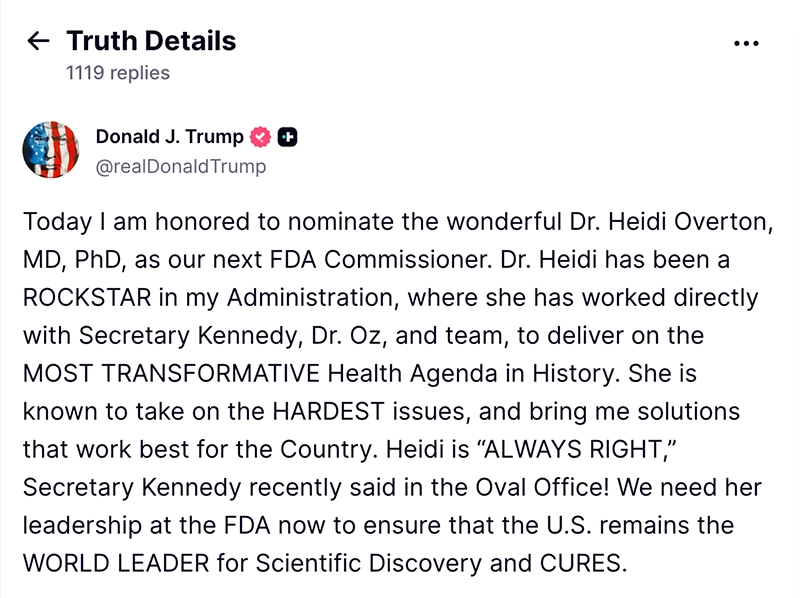
Who is Dr. Heidi Overton?
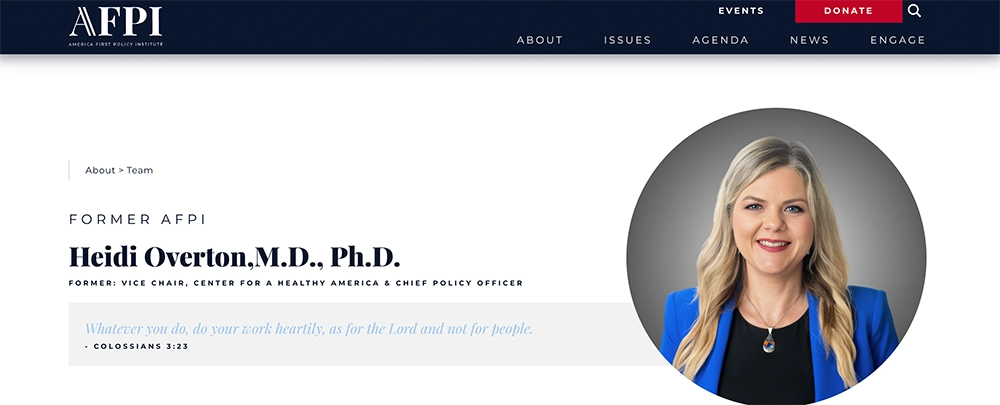
A physician originally from New Mexico, she earned her Ph.D. in clinical research from Johns Hopkins University and is board-certified in public health and preventive medicine. From 2019 to 2020, she was a White House Fellow. Prior to her current position as deputy advisor for domestic policy at the White House, she served as chief policy officer at the America First Policy Institute (AFPI). At this think tank, founded by former government officials, she led the Center for a Healthy America. She helped shape strategies aligned with the “America First” doctrine, which place a strong emphasis on national sovereignty, price transparency, and market-driven regulation through deregulation.
The “MAHA” Agenda
Experts view Overton's nomination as a sign of a change in direction for the FDA's leadership. As an advocate for the "Make America Healthy Again" (MAHA) agenda, she is calling for structural changes in the healthcare system:
In addition to her efforts to reduce bureaucratic hurdles, her positions on health policy are particularly notable: Overton opposes COVID-19 restrictions and supports initiatives to fundamentally overhaul established plans for childhood vaccinations. She has also taken a clear stand against gender-affirming surgeries for minors and has described the abortion drug mifepristone—which the FDA has so far classified as safe—as dangerous.
Unclear Timeline and Obstacles in the Senate
Whether Overton will actually take office will be determined by the U.S. Senate's formal confirmation process. A specific date for the vote has not yet been set; the process is expected to be completed sometime between September and December 2026.
The confirmation is far from certain. Since Democrats are likely to unanimously reject the nomination due to Overton’s stance on vaccinations and reproductive rights, it depends on the slim Republican majority. But the nomination is also facing resistance within the party: Dr. Bill Cassidy, a physician and Republican senator who chairs the pivotal Health, Education, Labor, and Pensions (HELP) Committee, publicly described Overton’s involvement in controversial executive orders altering vaccination plans as “nearly disqualifying.” Since Cassidy controls the scheduling of the hearings, the next steps are largely in his hands.
A Possible New Direction for Europe
As the world’s most influential regulatory agency, the FDA sets global standards for drugs and medical devices. Since European pharmaceutical companies generate significant revenue in the U.S. market, a reorientation of the FDA under Overton would also have consequences for Europe:
Market Access and Approval Timelines
If the FDA were to speed up its approval processes through far-reaching deregulation, the European Medicines Agency (EMA) would face significant pressure to adapt. Even today, European pharmaceutical companies are shifting their initial approvals to the U.S. when faster market entry is on the horizon there. If the U.S. further relaxes its criteria, the EMA will face a regulatory dilemma: either maintain European safety standards or follow suit for economic and competitive reasons.
Regulatory Decoupling
For decades, cooperation between the FDA and the EMA has been based on shared scientific standards. However, if future FDA leadership were to deviate from recognized scientific consensus—for example, in the evaluation of vaccines—international harmonization would be jeopardized. Mutual recognition of clinical trials and trial data could be called into question. For global pharmaceutical companies, this would mean duplicative testing efforts and significantly higher development costs.
Restructuring of Global Supply Chains
A key economic policy priority on Overton’s agenda is the strategic reduction of U.S. dependence on Chinese raw materials (particularly active pharmaceutical ingredients, APIs) and the relocation of production capacity back to the United States. This trade policy offensive is forcing a restructuring of global supply chains. Since European manufacturers are also dependent on Asian raw materials, there is a risk of displacement effects in global procurement markets as well as rising production costs for medications in the EU.