DiGA: Caught in the Crossfire of Interest Groups

Six years after their market launch, digital health applications (DiGA) are now firmly established in healthcare. The GKV-Spitzenverband acknowledges this, but criticizes the costs. For the pharmaceutical industry, these applications have become an integral part of modern treatment pathways.

Image: Generated using AI
Hanna Sachse
May 13, 2026
GKV-Spitzenverband DiGA Report 2025 | SVDGV DiGA Report 2025

Key Facts: Figures, Data, and Sources of Studies

Boom and Budget (Sources: GKV-SV & SVDGV): By the end of 2025, the market will have recorded over 1.7 million redemptions. The year 2025 alone saw record growth of +64% (approx. 690,000 redemptions) and drove total GKV expenditures to over 400 million euros (171 million euros in 2025 alone).

The pricing dispute (Sources: DiGA Report by GKV-SV / DiGA Report by SVDGV): The health insurance association criticizes “economic support” totaling 119 million euros during the pilot year, as the manufacturers’ prices (average: 544 euros) are far above the negotiated prices (average: 227 euros). The SVDGV counters: The amounts represent legitimate compensation for immense upfront investments in clinical trials.

Patients and Trends (Sources: SVDGV / GKV-SV): DiGAs are not exclusively for young people. According to the SVDGV report, the 50- to 64-year-old age group is the largest user group, accounting for 40%. According to the GKV report, metabolic health apps (37% market share) are the primary drivers of the market, led by Oviva Direkt, which is projected to account for 44% of all redemptions in 2025.

Scientific Standard (Source: SVDGV): Despite bureaucratic hurdles (BSI certification extends approval from 3 to 9 months), approximately 70% of the apps achieve permanent listing. Currently, 8 out of 9 provisionally listed DiGAs are already demonstrating their efficacy through RCT studies (the scientific gold standard).

Strategic Pharmaceutical Factor (Source: Digital Oxygen Industry Analysis): Pharmaceutical companies (such as Bayer Vital, Pohl-Boskamp, and MEDICE) are increasingly using DiGAs for “Drug + Digital” models (blended care). The goal is to use apps to ensure adherence to traditional medications and to leverage new real-world data from the Research Data Center (FDZ).

The Numbers and Different Interpretations

With over 1.7 million uses, DiGA are viewed as an integral part of healthcare in Germany, both by the GKV-Spitzenverband (GKV-SV) and the Spitzenverband Digitale Gesundheitsversorgung (SVDGV). This is because the figures as of December 31, 2025, show significant growth: In 2025 alone, approximately 690,000 activation codes were redeemed, an increase of 64% compared to the previous year. The cost to health insurance companies: a total of over 400 million euros, with over 170 million euros in 2025.

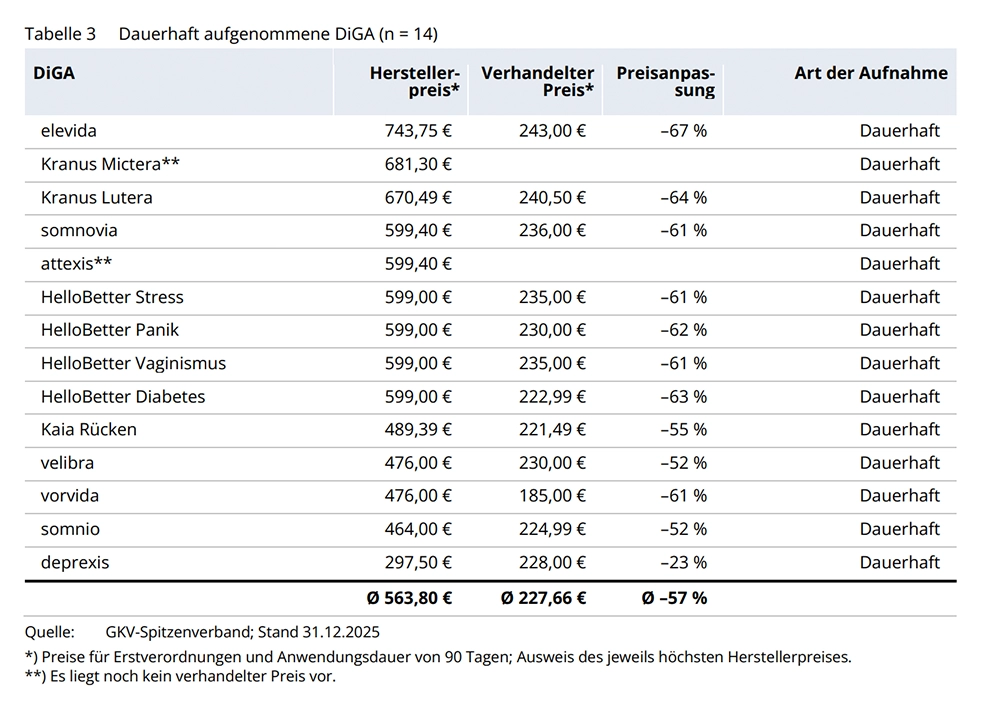
Average manufacturer-listed prices of 544 euros contrast with negotiated prices of 227 euros. The GKV Association refers to this as “start-up financing” funded by insurance premiums and calls for an end to pilot programs that lack final proof of benefit.

The SVDGV, however, rejects this characterization as “misleading.” It emphasizes that manufacturers must comply with maximum payment limits—which the GKV-SV itself helped negotiate—from day one. Furthermore, the amounts paid are not “financing,” but rather legally legitimate compensation for services that require significant investments in clinical trials and compliance with over a dozen new regulatory requirements.

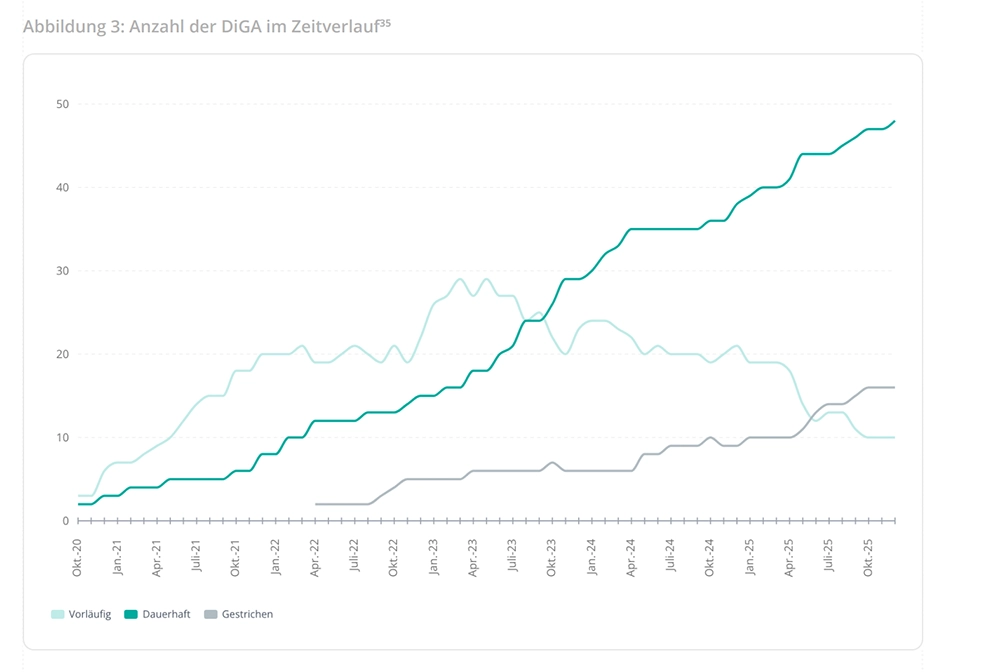
Over the entire period since the service was introduced, a total of 74 DiGAs were added to the DiGA directory; of these, 58 were still included in the GKV service catalog as of the end of 2025. Sixteen DiGAs (22%) were removed from the DiGA directory.

Evidence and Market Access

The trial year remains a key point of contention. The GKV-SV criticizes the fact that many digital health applications (DiGA) are reimbursed without having completed a proof of benefit. The SVDGV counters that systematic data analyses are already mandatory for provisional inclusion. It is noteworthy that currently, 8 out of 9 provisionally listed applications have already demonstrated their efficacy based on randomized controlled trials (RCTs), the scientific gold standard.

At the same time, increasing bureaucratic hurdles are weighing on the sector. According to manufacturers, the application process has been extended from three to as many as nine months due to complex data security requirements (BSI TR-03161). The industry warns that this could slow down digital innovation.

Marketing and Patient Autonomy

The health insurer’s report also criticizes “aggressive marketing” and “prescription services.” The SVDGV counters that lawmakers deliberately created a low-threshold access system in which a confirmed diagnosis (indication) is the decisive factor. The GKV-SV’s criticism, it argues, questionably disregards patients’ actual need for treatment and practitioners’ freedom to choose therapy.

Obesity Apps as Key Growth Drivers

One notable trend is the dominance of metabolic applications, which accounted for about 37% of usage in 2025. The Oviva Direkt app alone accounted for 44% of all redemptions in 2025.
‍

DiGA data recorded on a continuous basis. (Source: GKV-SV DiGA Report | Graphic: Screenshot by Hanna Sachse / PEIX)
Focus on Pharmaceuticals: Synergies and Strategic Positioning

For the pharmaceutical industry, the development of digital health applications (DiGA) is of great strategic importance, as it marks the transition from a pure product manufacturer to an integrated solutions provider.

So-called “prescription services” and marketing strategies focused on patients are viewed with particular skepticism.
Dr. Sigrid Bender and Torsten Christann of Digital Oxygen

‍

Classified by Bender and Christann:

This is exactly where the pharmaceutical industry comes into play. Many of the challenges facing the DiGA market mirror traditional issues in the pharmaceutical industry: generating evidence, assessing benefits, reimbursement policies, and integration into care pathways. Pharmaceutical companies have decades of experience in these areas and could become key partners for DiGA manufacturers.

Collaborations are already on the rise. Companies such as Bayer Vital are actively involved in digital therapy and care solutions; Pohl-Boskamp entered the DiGA market early on and is working on additional digital adherence approaches; and MEDICE has positioned itself as an active player in digital health through investments and platform strategies. Mid-sized pharmaceutical companies, in particular, see DiGAs as an opportunity to supplement traditional medications with digital care components.

Digital health applications (DiGA) are relevant to the pharmaceutical industry for several reasons. First, they enable closer patient monitoring between doctor’s visits and can improve adherence and treatment outcomes. Second, digital applications provide valuable real-world data on care and usage. Third, new “Drug + Digital” models are emerging in which medications and digital therapy options are designed in tandem—for example, in the treatment of obesity, mental health conditions, or chronic pain.

This is precisely where the pharmaceutical industry's new role could lie: as a bridge between innovation, evidence, and patient care.
Number of DiGAs over time. (Source: SVDGV DiGA Report | Graphic: Screenshot by Hanna Sachse / PEIX)

‍

If you'd like to know more:

Considerations for the Pharmaceutical Industry

â–Ş Blended Care as the Standard: In conditions such as obesity or diabetes, digital health interventions (DiGA) complement modern pharmacotherapies. They serve as digital companions that support lifestyle changes and thus ensure the success of medication-based treatment.

â–Ş Adherence and real-world data: Pharmaceutical companies benefit from improved treatment adherence through digital reminders and educational resources. The data from the Research Data Center (FDZ), which will be available starting in 2026, also offers new opportunities for health services research.

â–Ş Current status: Pharmaceutical companies are currently acting primarily as collaboration partners, investors, or distributors for specialized DiGA startups. However, the trend is toward deeper integration of digital components into the clinical development of new active ingredients.

▪ Evidence as a Competitive Factor: As RCT studies increasingly become the standard for long-term DiGA listing, the digital world is aligning with the pharmaceutical industry’s high scientific standards. This creates a common language for future combination therapies.

Summary of the Reports

These reports provide an overview of the period from October 2020 through December 31, 2025. This period thus covers the first five full calendar years of the market’s existence.

GKV-Spitzenverband's DiGA Report 2025 (Payer Perspective)

The GKV-Spitzenverband (GKV-SV) offers a mixed assessment. While digital health applications (DiGA) are recognized as an integral part of healthcare, the association warns of significant financial risks and structural disincentives.

Key findings:

Cost Spiral: Total statutory health insurance (GKV) expenditures on digital health applications (DiGA) rose to approximately 400 million euros (of which 171 million euros were spent in 2025 alone).

Price disparity: The average manufacturer's price (544 euros) is far higher than the price ultimately negotiated (227 euros). To date, this has resulted in "economic support" from the statutory health insurance system (GKV) totaling 119 million euros.

Dominance of Weight Loss Apps: For the first time, metabolic disorders (37%) account for the largest share of usage, driven by extreme growth in a single app (Oviva Direkt).

Criticism of Sales Practices: The GKV-SV criticizes aggressive marketing ("prescription services") and advertising aimed at the general public, which it says overshadows the medical benefits.

The GKV-SV is calling for negotiated prices to take effect from the first day of listing and for the trial regulation (provisional listing without final proof of benefit) to be abolished.

SVDGV’s DiGA Report 2025 (Manufacturer’s Perspective)

The German Digital Healthcare Association (SVDGV) is celebrating its fifth anniversary as a model of success, but sees its innovative strength threatened by bureaucracy.

Key Findings

Growth driver: Approximately 1.6 million activation codes redeemed by the end of 2025. Growth in 2025 was a remarkable 64% compared to the previous year.

Success Based on Evidence: About 70% of provisionally listed digital health applications (DiGA) achieve permanent listing after the pilot year.

User Demographics: Contrary to common stereotypes, people of all age groups use DiGA; the largest group consists of those aged 50 to 64 (40%).

Obstacles: The SVDGV criticizes the lengthy BSI certification process (data security), which extends the fast-track period from 3 to 9 months, as well as the heavy bureaucratic burden resulting from the new performance measurement system (AbEM).

â–Ş To keep DiGA competitive on the international stage, we need barrier-free access (e-prescriptions), practical data security measures, and European harmonization of reimbursement rules.

More Articles
Deepfake Medical Professionals: “You want real truth in advertising”
July 30, 2026
Agent-Based AI in Medicine: Potential, Practice, and Guidelines
July 23, 2026
Pharmaceutical Communication: The Celebrity Factor vs. Patient Trust
July 9, 2026

Kicking Off the Industry Dialogue: The New Forward Pharma Podcast

Kicking Off the Industry Dialogue: The New Forward Pharma Podcast
August 10, 2026
Listen now
Listen to the podcast
"FORWARD PHARMA"
analyzes the key trends in the healthcare and pharmaceutical industries. We provide context for current topics and speak with experts.
Click here for the
FORWARD PHARMA
Podcast